How Do Elder Care Agencies Match Seniors With Caregivers?

When families contact elder care agencies in Toronto, they are often asking a very personal question: “Who will actually be caring for my parent or loved one?” At Caregiver Referral Services Toronto Inc., we believe a good caregiver match starts by understanding the senior as a person; not simply listing a set of care tasks.
We begin by learning about the senior's daily routine, health-related needs, personality, preferences, living environment and the type of assistance the family is looking for. From there, we work to connect the family or facility with a caregiver whose experience, availability and approach are appropriate for the situation.
What Is the First Step in Matching a Senior With a Caregiver?
The first step is understanding what the senior actually needs from day to day. We ask families to describe the person's routine, preferences, challenges and desired schedule so that we can look for a more appropriate caregiver fit.
A senior may need only a few hours of companionship each day. Another person may require ongoing assistance with personal routines and mobility. Someone living with dementia may need a caregiver who understands changes in memory, communication and behaviour.
We therefore look beyond the question, “Does this person need a caregiver?” We ask:
What does a typical day look like?
What tasks require assistance?
Does the senior live alone?
Is mobility limited?
Is companionship important?
Is overnight or live-in support needed?
Does the senior have Alzheimer’s, Parkinson’s or another condition requiring particular experience?
Is the care taking place in a private home or a residential facility?
These answers give us a starting point for the referral process.
How Do We Decide What Type of Caregiver Is Appropriate?
We look at the senior's needs first and then consider the caregiver's relevant experience and availability. The goal is to create a practical match rather than simply fill an open shift.
For example, a senior who enjoys conversation, reading and walks may benefit from a caregiver who is comfortable providing companionship and encouraging everyday activities.
Another senior may need more hands-on assistance with daily routines. In that situation, the family may be looking for a caregiver with appropriate personal support experience. We may also consider whether the caregiver needs experience working in:
Private homes
Retirement homes
Nursing homes
Hospitals
Group settings
Other care facilities
The setting can change the nature of the support required, which is why we discuss the environment as part of the matching process.
Why Do Personality and Companionship Matter in Elder Care?
Personality matters because elder care is about more than completing a list of tasks. A caregiver may spend many hours with a senior, particularly in a live-in arrangement, so communication and companionship can strongly influence the day-to-day experience.
Consider two seniors. One may prefer a quiet caregiver who respects personal space. Another may enjoy conversation, games, music or regular social interaction. Neither preference is better than the other. They are simply different.
We encourage families to explain these preferences because they can help us identify caregivers who may be more comfortable in that particular environment. Companionship can also help a senior remain socially engaged. Canada's dementia guidance emphasizes the value of social connection, autonomy and person-centred support for people living with dementia.
How Do We Match Live-In and Live-Out Caregivers?
We match the arrangement to the household's schedule and level of support required. We provide referrals for both live-in and live-out caregivers.
A live-out caregiver may be suitable when a senior needs assistance during defined hours but does not require someone residing in the home. A live-in caregiver may be considered when a household needs a greater level of ongoing presence and support.
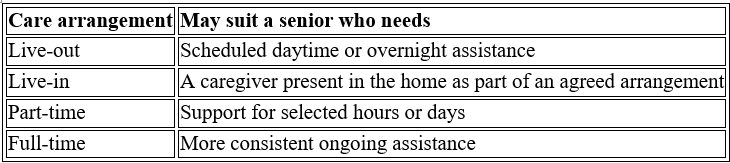
The exact duties and schedule should always be clearly discussed between the family, senior and caregiver.
What Changes When a Senior Has Alzheimer’s Disease?
Alzheimer’s disease can change the type of support a senior needs, so caregiver experience and communication become especially important. Memory loss, changes in judgement, communication difficulties and changes in daily functioning can affect ordinary routines.
For a senior living with Alzheimer’s, a caregiver may need to provide calm, consistent support while helping the person remain engaged in familiar activities. We encourage families to explain:
Known routines and preferences
Communication patterns
Activities the senior enjoys
Situations that may cause distress
Changes in daily functioning
Safety concerns that the family has identified
Dementia affects people differently, and symptoms can vary from person to person and even from day to day. The Government of Canada recommends person-centred approaches that support autonomy, dignity and quality of life.
We also recognize that dementia can place considerable pressure on family caregivers. Canada's 2025 dementia strategy report found that 35.3% of dementia caregivers experienced distress in 2023–2024. ( source). This is one reason families may look for additional support rather than trying to manage everything themselves.
Why Does Parkinson’s Disease Require Another Approach?
Parkinson’s disease can create care requirements that differ from ordinary age-related assistance. Changes in movement, balance and coordination may affect everyday activities, while non-motor symptoms can also influence sleep, mood, cognition and other aspects of daily life. When we discuss care for someone living with Parkinson’s, we therefore pay attention to the specific challenges affecting that person. For example, the family may explain that the senior needs assistance with:
Moving safely around the home
Maintaining an established daily routine
Getting to and from activities
Companionship
Practical household assistance
Mobility-related tasks
Parkinson Canada emphasizes that Parkinson’s affects people differently and that care needs can evolve over time. It also recommends building a coordinated care team as needs change. We see the caregiver as part of that broader support network; not a replacement for physicians, nurses or other regulated health professionals.
Can Caregivers Help With Mobility and Stair-Lift Operation?
Depending on the caregiver's role and the agreed care arrangement, practical support may include assistance with mobility routines and operating a stair lift. Safety remains the priority, and caregivers should only perform tasks that fall within their skills, responsibilities and instructions.
For a senior living in a multi-level home, a stair lift can make movement between floors easier. The caregiver may assist with the established routine around its use when this is part of the agreed responsibilities.
Families should explain the home's layout and any mobility concerns during the referral process. That information helps create a clearer picture of what the caregiver will encounter.
How Do We Consider the Senior's Living Environment?
The place where care occurs can influence the type of caregiver required. We provide caregiver referrals for seniors in private homes, retirement homes, nursing homes and other facilities.
For instance, a private home may involve companionship, household assistance and personal support. A retirement or nursing-home environment may involve coordination with an existing team and adherence to facility routines. The caregiver's role should therefore be clearly established before the arrangement begins.
What Happens When a Family Needs More Than Elder Care?
Our caregiver referral services extend beyond elderly care, allowing families and organizations to explore several types of caregiver support through one source. We align families, nursing homes, retirement homes, hospitals and other organizations with caregivers for different needs. Our referral services include:
· Elderly caregivers
· Nannies and childcare
· Personal Support Workers for private homes and businesses
· Newborn care
· Early Childhood Educators (ECEs) for organizations
· Tutors
· Housekeepers and cleaners
· Daycare workers
· Cooks
We can also discuss live-in, live-out, full-time and part-time caregiver arrangements depending on the requirement.
How Do We Handle Changing Care Needs?
A caregiver match should not be treated as permanent if the senior's circumstances change. Ageing, illness, recovery, mobility changes or a new diagnosis can alter what a person needs from a caregiver.
For example, someone may initially need companionship for a few hours a week. Later, the family may require more frequent support.
Parkinson Canada similarly notes that care needs can evolve and that a person's care team may need to change as the condition progresses. We encourage families to communicate changes rather than waiting until an arrangement becomes difficult to manage.
How Can Families Make a Caregiver Match Work Well?
A successful caregiver arrangement depends on clear expectations from everyone involved. Families can make the transition easier by sharing useful information before the caregiver begins. A simple preparation process can include:
Step 1: Explain the routine
The family can describe meal times, preferred activities, rest periods and usual schedules.
Step 2: Identify important care requirements
Mobility, companionship, personal support and other responsibilities should be discussed clearly.
Step 3: Explain preferences
Language, personality, cultural considerations and lifestyle preferences may all be relevant.
Step 4: Clarify responsibilities
Everyone should understand what the caregiver is expected to do.
Step 5: Keep communication open
If something changes, the family and caregiver should discuss it rather than allowing confusion to build.
Why Is the Right Match About More Than a Résumé?
Experience matters, but a caregiver's résumé is only one part of a good match. We also consider the senior's personality, routine, environment and practical requirements.
A caregiver may have extensive experience but not be the right fit for every household. Conversely, a caregiver with the appropriate experience and a compatible approach may create a more comfortable day-to-day relationship.
Our role is to understand the requirements and make caregiver referrals accordingly. For families, the goal is simple: the senior should receive support that respects their dignity, routine and individuality.
About Caregiver Referral Services Toronto Inc.
Caregiver Referral Services Toronto Inc. is a Toronto-based caregiver referral service that has been connecting Canadians in need of care with caregivers since 1999. We align families, nursing homes, retirement homes, hospitals and other organizations with caregivers for elderly care, childcare and a range of other support needs.
Families and organizations looking for an elder care agency in Mississauga, Toronto can talk to us today for more information. Our focus is on understanding each request and helping connect the client with a caregiver suited to the stated requirements.
Frequently Asked Questions
1. How do elder care agencies match seniors with caregivers?
We begin by understanding the senior's care requirements, routine, living environment, schedule and preferences. We then consider caregiver experience, availability and suitability when making a referral.
2. Can caregivers provide support for seniors with Alzheimer’s?
Care requirements for someone living with Alzheimer’s can be more specialized. Families should discuss the senior's symptoms, routines and support needs so that an appropriate caregiver referral can be considered.
3. Do you provide caregivers for seniors with Parkinson’s disease?
Yes, we can discuss caregiver referrals for seniors living with Parkinson’s. The specific needs should be explained because Parkinson’s can affect movement, balance, sleep, cognition, mood and daily routines differently from one person to another.
4. Do you offer live-in and live-out elder caregivers?
Yes. We provide referrals for both live-in and live-out caregivers, with full-time and part-time arrangements available depending on the family's or facility's requirements.
5. Can caregivers work in nursing homes and retirement homes?
Yes. We align caregivers with private homes as well as retirement homes, nursing homes, hospitals and other facilities, depending on the requested arrangement.
6. Do you provide other types of caregivers besides elderly caregivers?
Yes. Our services also include nannies and childcare, PSWs, newborn care, ECEs, tutors, housekeepers and cleaners, daycare workers and cooks.
Author Bio
This blog is prepared by Caregiver Referral Services Toronto Inc. Team who has been connecting Canadian families and organizations with caregivers since 1999. The team supports families, hospitals, nursing homes and retirement homes with caregiver referrals tailored to individual needs. Their expertise covers elderly care, PSWs, childcare, newborn care and other in-home support services.